
Quick Answer
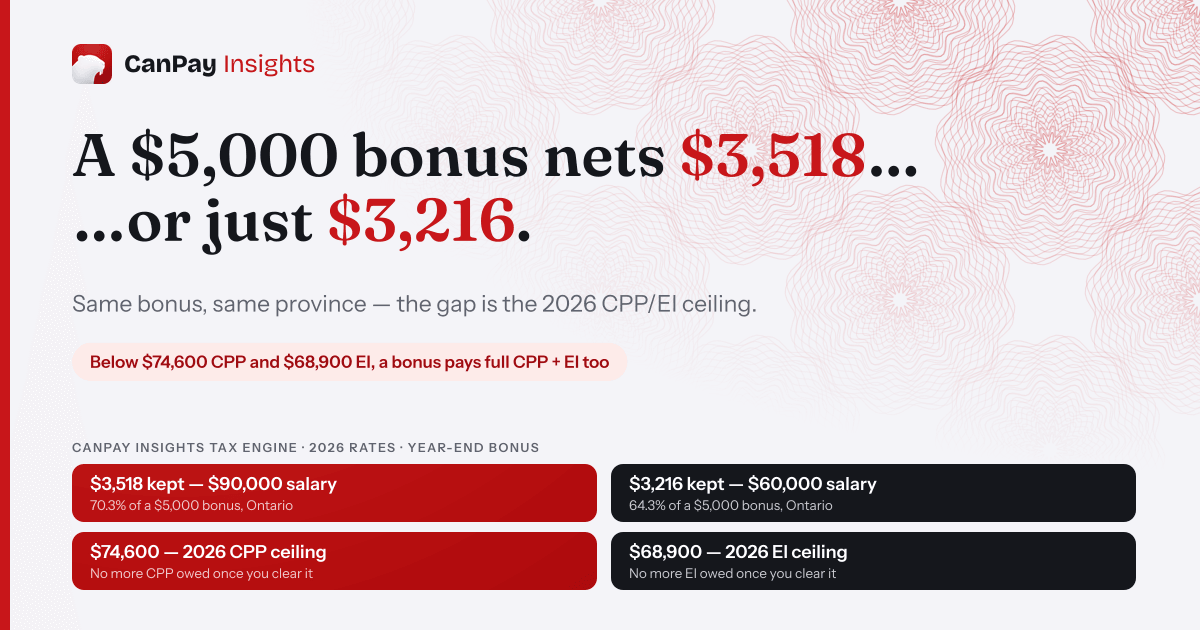
A year-end bonus is taxed as ordinary employment income, not at some special higher rate — any extra withholding your employer applies at bonus time is just a withholding method; what you actually keep depends on your marginal tax rate and whether you've already hit the 2026 CPP ($74,600 maximum pensionable earnings) and EI ($68,900 maximum insurable earnings) ceilings for the year. Run through the CanPay Insights tax engine, a $5,000 bonus on a $60,000 Ontario salary (below both ceilings) nets $3,216, or 64.3%; the same $5,000 bonus on a $90,000 Ontario salary (above both ceilings) nets $3,517.50, or 70.4%, because it skips CPP and EI entirely and loses only income tax. The gap is smaller but still real in every other province checked.
A bonus isn't taxed differently — but where it lands is
Year-end bonus season raises the same question every year: how much of it do you actually keep? The short answer is that a bonus is ordinary employment income, taxed at your marginal rate once it's added to everything else you earned in the year — there is no separate "bonus tax rate." What an employer withholds from the bonus cheque itself can look higher, because payroll software often uses the CRA's bonus method to calculate withholding on an irregular payment, but that's just a withholding mechanic. It settles out at tax time either way.
What genuinely changes how much of a bonus you keep is whether your salary has already passed this year's CPP and EI ceilings — the points past which no more CPP or EI is deducted for the rest of the calendar year. For 2026, those are:
- CPP maximum pensionable earnings: $74,600
- EI maximum insurable earnings: $68,900
Once your year-to-date earnings clear both, a bonus on top loses nothing to CPP or EI — only income tax. Below both, it loses the full CPP (5.95%) and EI (1.63%) rates on top of tax, same as any other dollar of pay.
We ran $1,000, $2,000, and $5,000 bonuses through the CanPay Insights tax engine at two salaries — $60,000 (below both ceilings) and $90,000 (above both) — for a single filer paid bi-weekly, in every province.
Key findings
- A $5,000 bonus on a $60,000 Ontario salary nets $3,216 (64.3%). The same $5,000 bonus on a $90,000 Ontario salary nets $3,517.50 (70.4%) — six points more, almost entirely because the higher salary has already cleared the CPP and EI ceilings for the year.
- The gap between the two salaries holds in every province checked, though its size varies with provincial tax brackets: from about 2.6 points in Prince Edward Island to about 6.5 points in Quebec.
- Bonus size barely changes the percentage kept, at a given salary. A $1,000 and a $5,000 bonus keep almost the same share, because both usually sit inside the same tax bracket — it's the salary underneath the bonus, not the bonus's own size, that moves the percentage.
- British Columbia keeps the largest share of a bonus at both salaries checked; Quebec and Nova Scotia keep the smallest.
What a bonus nets you, by province — $60,000 salary (below the 2026 CPP/EI ceilings)
Add the bonus to a $60,000 salary and gross income for the year becomes $61,000, $62,000, or $65,000.
| Province | $1,000 bonus nets | $2,000 bonus nets | $5,000 bonus nets |
|---|---|---|---|
| British Columbia | $657.92 (65.8%) | $1,315.83 (65.8%) | $3,289.58 (65.8%) |
| Alberta | $656.53 (65.7%) | $1,308.75 (65.4%) | $3,218.93 (64.4%) |
| Ontario | $643.20 (64.3%) | $1,286.40 (64.3%) | $3,216.00 (64.3%) |
| Saskatchewan | $613.62 (61.4%) | $1,227.24 (61.4%) | $3,068.11 (61.4%) |
| Manitoba | $611.34 (61.1%) | $1,222.69 (61.1%) | $3,056.72 (61.1%) |
| Prince Edward Island | $603.36 (60.3%) | $1,206.72 (60.3%) | $3,016.80 (60.3%) |
| New Brunswick | $598.05 (59.8%) | $1,196.09 (59.8%) | $2,990.24 (59.8%) |
| Newfoundland and Labrador | $592.64 (59.3%) | $1,185.27 (59.3%) | $2,963.18 (59.3%) |
| Nova Scotia | $588.24 (58.8%) | $1,176.48 (58.8%) | $2,900.03 (58.0%) |
| Quebec | $570.35 (57.0%) | $1,140.71 (57.0%) | $2,851.77 (57.0%) |
What a bonus nets you, by province — $90,000 salary (above the 2026 CPP/EI ceilings)
Add the bonus to a $90,000 salary and gross income for the year becomes $91,000, $92,000, or $95,000.
| Province | $1,000 bonus nets | $2,000 bonus nets | $5,000 bonus nets |
|---|---|---|---|
| British Columbia | $718.00 (71.8%) | $1,436.00 (71.8%) | $3,590.00 (71.8%) |
| Ontario | $703.50 (70.4%) | $1,407.00 (70.4%) | $3,517.50 (70.4%) |
| Alberta | $695.00 (69.5%) | $1,390.00 (69.5%) | $3,475.00 (69.5%) |
| Saskatchewan | $670.00 (67.0%) | $1,340.00 (67.0%) | $3,350.00 (67.0%) |
| Manitoba | $667.50 (66.8%) | $1,335.00 (66.8%) | $3,337.50 (66.8%) |
| New Brunswick | $655.00 (65.5%) | $1,310.00 (65.5%) | $3,275.00 (65.5%) |
| Newfoundland and Labrador | $643.25 (64.3%) | $1,280.25 (64.0%) | $3,191.25 (63.8%) |
| Quebec | $635.03 (63.5%) | $1,270.06 (63.5%) | $3,175.14 (63.5%) |
| Nova Scotia | $628.30 (62.8%) | $1,256.60 (62.8%) | $3,141.50 (62.8%) |
| Prince Edward Island | $629.00 (62.9%) | $1,258.00 (62.9%) | $3,145.00 (62.9%) |
Why the gap exists
Compare Ontario at both salaries: a $5,000 bonus nets $3,216 (64.3%) at $60,000, but the same $5,000 bonus nets $3,517.50 (70.4%) at $90,000 — a 6.0-point gap. Ontario's own marginal income tax rate is actually higher around $90,000 than around $60,000, which should cut the other way. The reason the bonus still nets more at $90,000 is that CPP (5.95%) and EI (1.63%) — nearly 7.6 cents of every dollar between them — simply don't apply once the salary underneath has already passed $74,600 and $68,900 for the year. The income tax bite grows a little; the CPP/EI bite disappears entirely; the second effect wins.
What this means for your own bonus
If your 2026 salary is already above $74,600, a year-end bonus on top of it will cost you only income tax — no CPP, no EI. If it's below that, expect the bonus to carry the same CPP and EI load as a regular paycheque, on top of tax. Either way, the actual percentage kept depends on your real salary, province, and how your employer's payroll already withheld CPP and EI earlier in the year. To check your own numbers, use the free CanPay Insights take-home pay calculator, or see the mechanics of why one extra dollar of income is taxed differently from your average dollar in the marginal vs. average tax rate guide. For deductions on their own, see the CPP & EI calculator; for a province-by-province view of take-home pay generally, see compare provinces or the Ontario and British Columbia paycheck calculators used above.
Sources & disclaimer
The 2026 CPP maximum pensionable earnings ($74,600) and EI maximum insurable earnings ($68,900) are the figures the Canada Revenue Agency and Service Canada publish each year for CPP and EI payroll deductions, and match the constants the CanPay Insights tax engine already uses throughout its 2026 coverage, including our CPP 2027 ceiling article and EI premium rate article. The general description of the CRA's bonus withholding method reflects how Canadian payroll software commonly calculates withholding on irregular payments; it describes withholding only, not final tax liability, which this article computes directly. All bonus and take-home figures are calculated by the CanPay Insights tax engine using 2026 federal and provincial tax brackets, CPP/CPP2, and EI, for a single filer with basic personal amounts only, paid bi-weekly, with no other deductions or credits claimed. This is general information, not financial or tax advice.
Calculate Your Take-Home Pay
Enter your salary and province to see detailed tax breakdowns instantly.
Use Free CalculatorFrequently Asked Questions
Is a bonus taxed at a higher rate than regular salary in Canada?
Why does the same $5,000 bonus net more at a higher salary?
What does a $1,000 or $2,000 bonus actually net, province by province?
Does it matter when in the year I receive the bonus?
Which province keeps the most of a bonus, and which the least?
Is this the same as how my employer will actually withhold tax from my bonus cheque?
Share this article
Help others learn about Canadian taxes
Disclaimer: This content is based on publicly available information and general tax knowledge for reference only. Individual tax situations may vary. Please consult a qualified tax professional or accountant for personalized advice.