Quick Answer
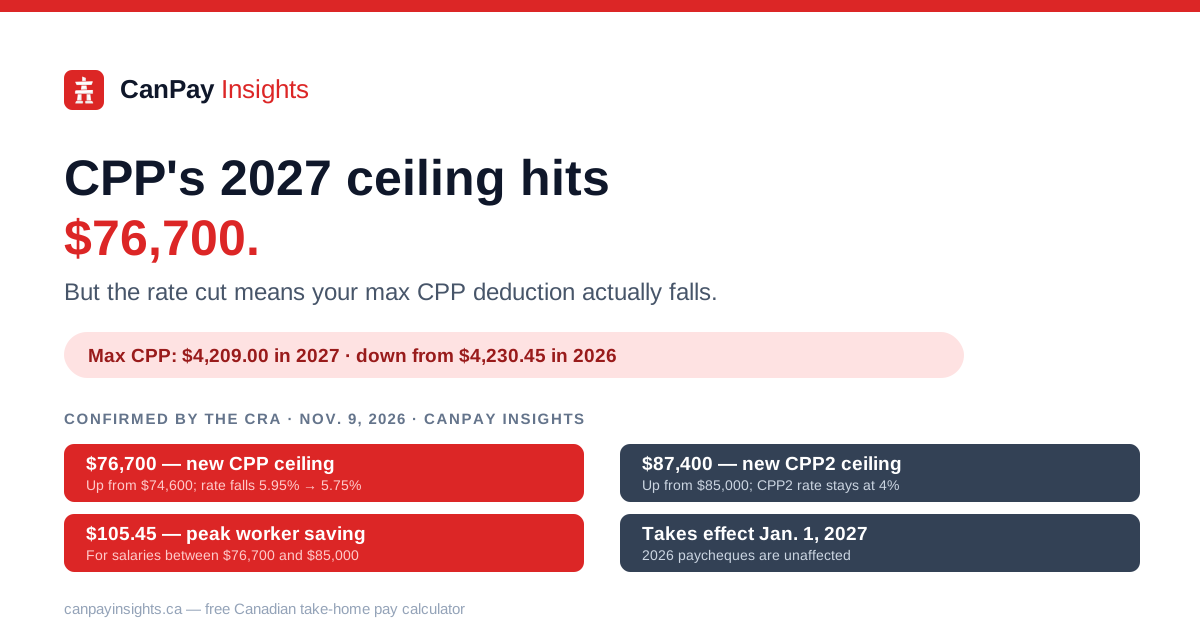
The Canada Revenue Agency has posted the 2027 CPP figures: the earnings ceiling (YMPE) rises to $76,700 from $74,600, and the second ceiling (YAMPE) rises to $87,400 from $85,000. Because the base CPP rate is also falling from 5.95% to 5.75% under the already-legislated Bill C-30 rate cut, the maximum base CPP deduction actually falls to $4,209.00 in 2027, down from $4,230.45 in 2026 — the first drop in years, even though the earnings ceiling went up. Including CPP2 (unchanged at 4% on earnings between the two ceilings), the combined maximum employee contribution falls slightly too, down from $4,646.45 to $4,637.00. Workers earning between $76,700 and $85,000 see the biggest dollar saving, $105.45; workers above $87,400 see the smallest, $9.45.
The number our own CPP rate-cut coverage was waiting on just landed
Back in the spring, Bill C-30 locked in a cut to the base CPP contribution rate, from 9.9% to 9.5% split between employer and employee (5.95% to 5.75% on the employee side), effective January 1, 2027. We covered that law in detail in our piece on the 2027 CPP rate cut — but at the time, one number was still missing: the 2027 CPP earnings ceiling, which the CRA typically confirms each November and hadn't yet when that article was written. Our federal budget preview flagged the same gap on November 2.
That number is now posted. The CRA's CPP contribution rates and maximums page on canada.ca carries a row explicitly marked "New 2027", and the registered-plans YMPE/YAMPE table confirms the same figures from a second angle:
| Figure | 2026 | 2027 | Change |
|---|---|---|---|
| Earnings ceiling (YMPE) | $74,600 | $76,700 | +$2,100 |
| Second ceiling (YAMPE) | $85,000 | $87,400 | +$2,400 |
| Basic exemption | $3,500 | $3,500 | No change |
| Base contribution rate (employee) | 5.95% | 5.75% | cut 0.20 pp |
| CPP2 rate (employee) | 4% | 4% | No change |
| Max base contribution (employee) | $4,230.45 | $4,209.00 | −$21.45 |
| Max CPP2 contribution (employee) | $416.00 | $428.00 | rose $12.00 |
| Max combined CPP + CPP2 (employee) | $4,646.45 | $4,637.00 | −$9.45 |
The counterintuitive part: the ceiling rose, but the maximum deduction fell
Normally, a higher earnings ceiling means a bigger maximum deduction — more income is subject to CPP, so the dollar cap climbs most years. Not this time. The ceiling climbed by $2,100, but the rate cut from 5.95% to 5.75% was large enough to more than offset it: 5.75% of the new $73,200 contributory-earnings band ($76,700 minus the $3,500 exemption) comes to $4,209.00, about $21 less than the $4,230.45 that 5.95% produced on the smaller 2026 band. This is the first year-over-year drop in the maximum base CPP contribution in recent memory — a direct, deliberate result of the rate cut, not an accident of indexing.
CPP2 moves the other way, but by less. The CPP2 rate itself didn't change — it's still 4% for employees and employers, 8% for the self-employed — but the band it applies to widened from $10,400 (between $74,600 and $85,000) to $10,700 (between $76,700 and $87,400), so the maximum CPP2 contribution rises from $416.00 to $428.00, a $12.00 increase. (The CRA's CPP2-specific maximums page did not have a 2027 row at the time of writing; the $428.00 and $856.00 self-employed figures above are CanPay Insights' own calculation — 4% and 8% respectively of the confirmed $10,700 band between the two confirmed ceilings — not a figure quoted directly from a CRA table.)
Net effect: the base-rate saving ($21.45) outweighs the CPP2 increase ($12.00), so the combined maximum CPP + CPP2 contribution still falls, from $4,646.45 to $4,637.00 — a $9.45 reduction for anyone earning at or above the top ceiling.
What this is worth at your salary
The saving isn't the same for everyone. It grows as your income approaches the 2026 ceiling, peaks for a band of upper-middle earners, then shrinks again at the very top:
| Annual salary | 2026 CPP + CPP2 | 2027 CPP + CPP2 | Saving |
|---|---|---|---|
| $40,000 | $2,171.75 | $2,098.75 | $73.00 |
| $50,000 | $2,766.75 | $2,673.75 | $93.00 |
| $60,000 | $3,361.75 | $3,248.75 | $113.00 |
| $70,000 | $3,956.75 | $3,823.75 | $133.00 |
| $76,700 | $4,314.45 | $4,209.00 | $105.45 |
| $85,000 | $4,646.45 (max) | $4,541.00 | $105.45 |
| $87,400 or more | $4,646.45 (max) | $4,637.00 (max) | $9.45 |
CPP + CPP2 for 2027 uses the confirmed 5.75% base rate on pensionable earnings between the $3,500 exemption and the YMPE, plus 4% CPP2 between the YMPE and the YAMPE. CPP + CPP2 for the prior year uses that year's 5.95% base rate and the same 4% CPP2 rate on its own ceilings. Figures assume a single employment income with no other CPP-exempt periods.
The pattern has a simple explanation. Below the 2026 ceiling, only the rate cut is in play, so the saving grows steadily with income — roughly 20 cents of saving per $100 of pensionable earnings. Between $76,700 and $85,000, the saving hits its peak of $105.45: earners here get the full base-rate cut while still paying noticeably less CPP2 than before, because 2027's CPP2 doesn't start until $76,700 instead of $74,600. Above $87,400, both years are maxed out on every component, so the saving collapses to the smallest, flattest number in the table: $9.45, the net of the $21.45 base-rate saving and the $12.00 CPP2 increase.
None of this touches a 2026 paycheque
Every figure above takes effect with pay dated January 1, 2027 or later. Your CPP deduction for the rest of 2026 stays exactly where it's been all year — 5.95% up to $74,600, plus 4% CPP2 up to $85,000. See how much CPP you pay in 2026 for this year's numbers in full, or how much EI you pay in 2026 for the other payroll deduction that moves independently of CPP (EI's own 2027 rate, already confirmed separately by the CEIC, is covered in our EI premium piece).
See it against your own paycheque
For your exact 2026 take-home pay under today's rules, use the free take-home pay calculator, or see this year's CPP and EI deductions broken out on their own with the CPP & EI calculator.
Sources & disclaimer
The 2027 CPP earnings ceiling ($76,700), the second ceiling ($87,400), the basic exemption ($3,500), the base contribution rate (5.75%), and the maximum base contribution ($4,209.00, with a combined employee-and-employer maximum of $8,418.00) are quoted directly from the Canada Revenue Agency's "Canada Pension Plan contribution rates, maximums and exemptions" page, which carries the figures in a row marked "New 2027". That CRA page's own details are dated November 9, 2026. The 2027 YMPE ($76,700) and YAMPE ($87,400) are independently confirmed on the CRA's "MP, DB, RRSP, DPSP, ALDA, TFSA limits, YMPE and the YAMPE" page. The CPP2 contribution rate (4% employee/employer, 8% self-employed) is unchanged from the CRA's existing CPP2 guidance and CanPay Insights' own prior reporting in the 2027 CPP rate cut piece; the 2027 CPP2 dollar maximums ($428.00 employee/employer, $856.00 self-employed) are CanPay Insights' own calculation from the confirmed 2027 ceilings and are not quoted from a CRA table, since the CRA's CPP2-specific maximums page had not been updated with a 2027 row at the time of writing. The Bill C-30 base-rate cut itself (9.9% to 9.5%, split 5.95%-to-5.75% on the employee side) received Royal Assent on June 18, 2026, as covered in our prior reporting. All salary-band figures are CanPay Insights' own arithmetic applying the confirmed rates and ceilings; this is general information, not tax advice.
Calculate Your Take-Home Pay
Enter your salary and province to see detailed tax breakdowns instantly.
Use Free CalculatorFrequently Asked Questions
What is the 2027 CPP earnings ceiling (YMPE)?⌄
Why is the maximum CPP deduction going down if the earnings ceiling is going up?⌄
What is the CPP2 ceiling (YAMPE) for 2027, and does CPP2 change too?⌄
How much will I actually save on CPP in 2027 compared to 2026?⌄
Is this confirmed, or still a projection like the TFSA limit?⌄
Does any of this change my 2026 paycheque right now?⌄
Share this article
Help others learn about Canadian taxes
Disclaimer: This content is based on publicly available information and general tax knowledge for reference only. Individual tax situations may vary. Please consult a qualified tax professional or accountant for personalized advice.