Quick Answer
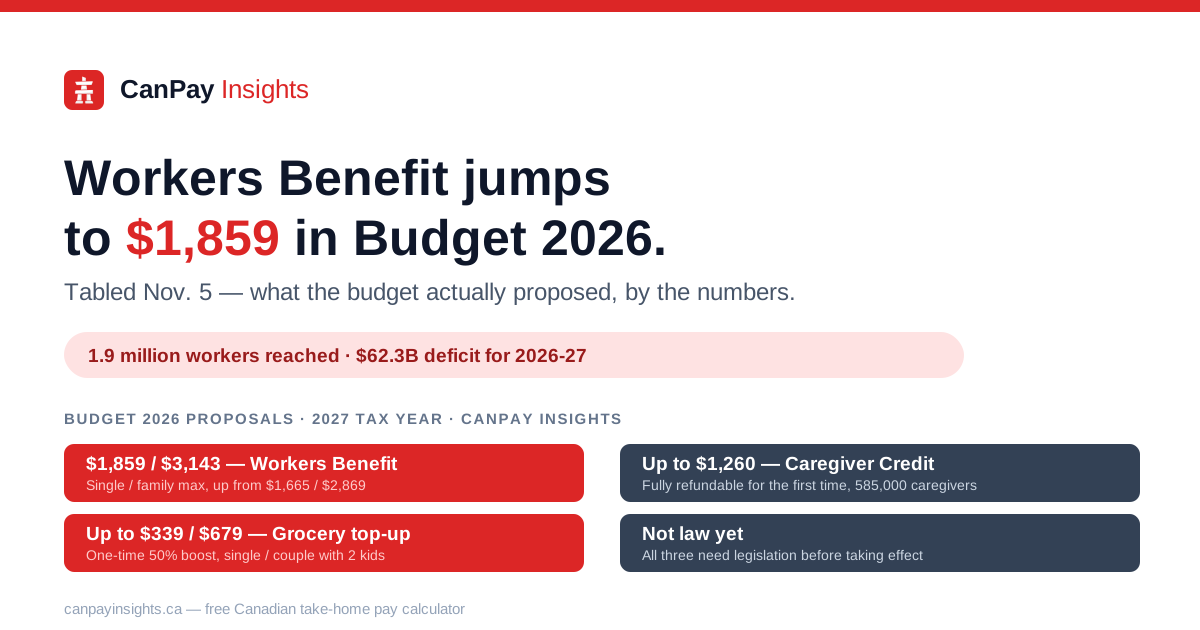
Budget 2026, tabled November 5, 2026, raises the maximum Canada Workers Benefit (renamed the "Build Canada Workers Benefit") to $1,859 for single workers and $3,143 for families starting the 2027 tax year, up from $1,665 and $2,869 for 2026 — reaching an estimated 1.9 million low-income workers, including 180,000 who get nothing from it today. The Canada Caregiver Credit becomes fully refundable for the first time starting in 2027, worth up to $1,260 a year for an estimated 585,000 caregivers, and a one-time 50% top-up to the Canada Groceries and Essentials Benefit — up to $339 for a single person and $679 for a couple with two children — lands in early 2027. None of this changes a 2026 paycheque, and all of it still needs to pass as legislation.
Budget 2026 landed November 5 — this time, with actual numbers
On November 5, 2026, Finance Minister François-Philippe Champagne tabled Budget 2026 in the House of Commons, putting the federal deficit for 2026-27 at $62.3 billion — smaller than the Parliamentary Budget Officer's pre-budget estimate of $63.3 billion, and well below the PBO's original June forecast of $71.8 billion. Our pre-budget coverage laid out what was already legally locked in for 2027 paycheques regardless of what the budget said — the CPP rate cut, the EI premium increase, the RRSP limit. This article covers what the budget itself actually proposed on top of that: three measures that reach a paycheque or a tax refund directly. None of them changes a 2026 payroll deduction, and none of them is law yet — each still needs to pass as legislation before it takes effect.
The Canada Workers Benefit becomes the "Build Canada Workers Benefit" — and gets bigger
The single biggest change for workers' take-home income is a rename and enhancement of the Canada Workers Benefit (CWB), rebranded the Build Canada Workers Benefit (BCWB), starting with the 2027 tax year.
| Measure | 2026 (current) | 2027 (proposed) | Change |
|---|---|---|---|
| Max basic benefit, single worker | $1,665 | $1,859 | +$194 |
| Max basic benefit, family | $2,869 | $3,143 | +$274 |
| Minimum earnings to qualify | $3,000 | $500 | −$2,500 |
| Disability supplement earnings threshold | $1,150 | $200 | −$950 |
| Workers reached | ~current base | 1.9 million, incl. 180,000 new | — |
| People lifted out of poverty | — | ~240,000 | — |
Some of that increase is ordinary inflation indexing, which would have happened with or without a budget: under the CWB's existing formula, the 2027 maximum would have climbed on its own to roughly $1,709 for singles and $2,943 for families. Budget 2026 goes further than that baseline, to $1,859 and $3,143 — a genuine enhancement of about $150 and $200 respectively, on top of indexing.
The bigger practical change for low-income workers may be the earnings threshold. Today you need $3,000 of working income before the basic CWB starts phasing in; that drops to $500. The disability supplement's own threshold falls from $1,150 to $200. Together, Finance Canada estimates the changes reach 1.9 million low-income workers — 180,000 of whom get nothing from the benefit as it exists today — and lift roughly 240,000 people out of poverty.
One more change: advance payments (the quarterly ACWB instalments covered in our 2026 CWB piece) are being wound down. They drop starting in July 2027 and are eliminated entirely from the 2028 tax year onward, after which the full BCWB arrives as a lump sum once you file your return rather than in instalments through the year.
The Canada Caregiver Credit becomes refundable for the first time
Budget 2026 also makes the Canada Caregiver Credit fully refundable, starting with the 2027 tax year, worth up to $1,260 annually (indexed in future years for an adult dependant; a related amount applies for a spouse, common-law partner, or child under 18).
The credit has existed for years, but as a non-refundable credit it only reduced tax owing — a caregiver with income too low to owe tax got nothing from it at all, no matter how much caregiving they did. Making it refundable fixes that specific gap. The government estimates 585,000 caregivers will receive the credit once it is refundable, including about 180,000 who currently get no benefit from it whatsoever, lifting an estimated 15,000 people out of poverty.
A one-time grocery top-up lands in early 2027
The third measure is narrower and temporary: a one-time 50% top-up to the 2026-27 Canada Groceries and Essentials Benefit (the benefit that replaced the GST/HST credit in July 2026 — see our coverage of that change), paid in early 2027 on top of the usual quarterly payments. It is worth up to $339 for a single person with no children and up to $679 for a couple with two children — on top of, not instead of, the 25% increase to the underlying benefit amount that already took effect in July 2026.
None of this is law yet
Every figure above is a budget proposal, not a confirmed payroll or benefit change. Past budget measures that touched take-home income took months to become law: the 2027 CPP rate cut was announced in April 2026 and needed a full bill, Bill C-30, plus sign-off from every provincial finance minister, before receiving Royal Assent on June 18, 2026 — eight months start to finish. The Build Canada Workers Benefit, the refundable Caregiver Credit, and the grocery top-up all need to clear Parliament the same way before any of the numbers above land in an actual bank account. CanPay Insights will cover the specifics again once each measure is actually confirmed in force, not before.
What this doesn't change
None of the three measures above adjusts a 2026 or 2027 payroll deduction — no change to CPP, EI, or federal/provincial tax withholding comes out of this budget. The 2027 numbers that already were locked in before the budget — the CPP rate cut, the EI premium increase, the RRSP dollar limit — are unaffected and covered in full in our pre-budget article and in the dedicated pieces on the CPP rate cut, the EI premium rate, and the TFSA and RRSP limits.
See where you stand right now
For your exact 2026 take-home pay under today's rules, use the free take-home pay calculator, or the CPP & EI calculator to see this year's deductions broken out on their own.
Sources & disclaimer
The November 5, 2026 budget date, the $62.3-billion deficit figure, and the Build Canada Workers Benefit, Canada Caregiver Credit, and Canada Groceries and Essentials Benefit measures are drawn from the Department of Finance Canada's own "Budget 2026: Key Measures" backgrounder (canada.ca, November 2026), cross-checked against reporting from The Globe and Mail ("Budget 2026: Ottawa bets spending boost will deliver future economic gains") and Daily Hive ("Here's how Canada's 2026 federal budget could save you money"), both published November 5-6, 2026. The 2026 CWB baseline figures match CanPay Insights' own prior reporting in our July 2026 Canada Workers Benefit piece, sourced to the CRA. All 2027 figures are budget proposals and not yet law; this is general information, not financial or tax advice.
Calculate Your Take-Home Pay
Enter your salary and province to see detailed tax breakdowns instantly.
Use Free CalculatorFrequently Asked Questions
What did Budget 2026 do to the Canada Workers Benefit?⌄
How much of that increase is just inflation indexing?⌄
What changed with the Canada Caregiver Credit?⌄
What is the one-time Canada Groceries and Essentials Benefit top-up?⌄
Does any of this change my paycheque right now?⌄
What is Budget 2026's deficit, and how does it compare to earlier estimates?⌄
Share this article
Help others learn about Canadian taxes
Disclaimer: This content is based on publicly available information and general tax knowledge for reference only. Individual tax situations may vary. Please consult a qualified tax professional or accountant for personalized advice.