Quick Answer
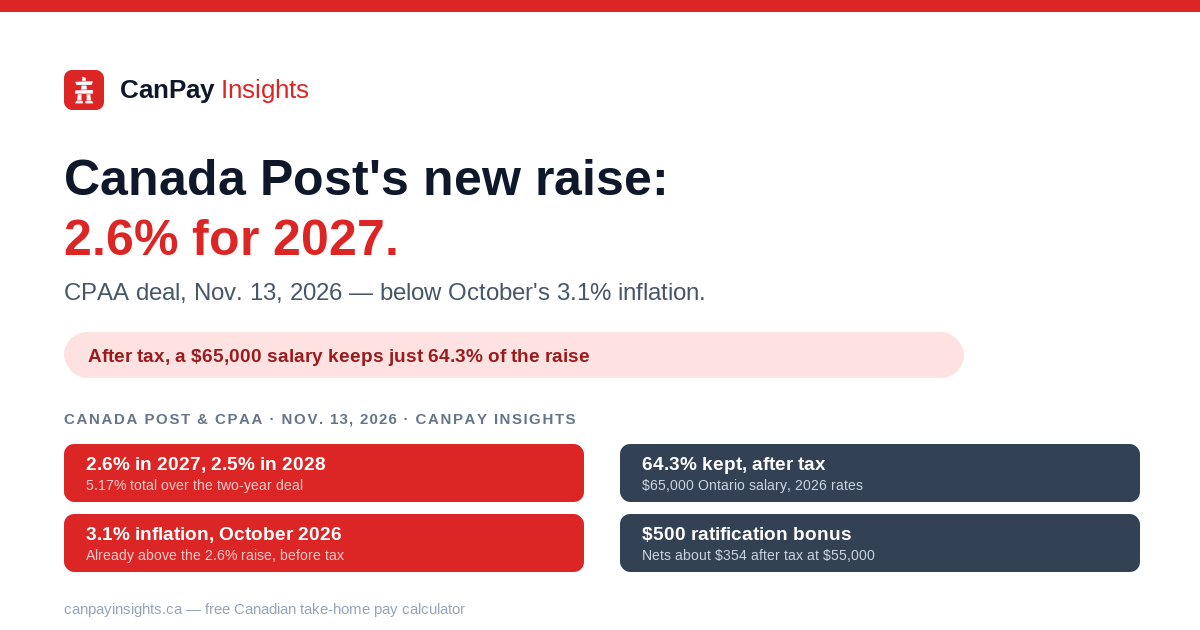
On November 13, 2026, Canada Post and the Canadian Postmasters and Assistants Association (CPAA) — the company's second-largest union, representing rural postmasters and their assistants — reached a tentative two-year deal: a 2.6% wage increase effective 2027 and 2.5% in 2028 (5.17% combined), plus a one-time ratification bonus of $500 for postmasters and other full-time employees ($250 for everyone else), non-pensionable. Run through the CanPay Insights tax engine at 2026 rates, a 2.6% raise on a $65,000 Ontario salary — $1,690 more a year — keeps only $1,087, or 64.3%, after federal and provincial tax, CPP, and EI; at $55,000 it keeps 70.8%. Because Statistics Canada's October 2026 inflation reading held at 3.1%, a 2.6% raise does not even keep pace with the cost of living before any deduction comes off it, let alone after.
A smaller raise than last time, for Canada Post's rural postmasters
On November 13, 2026, Canada Post announced a tentative two-year collective agreement with the Canadian Postmasters and Assistants Association (CPAA) — the company's second-largest union, representing postmasters and their assistants who mainly run rural post offices across Canada. CPAA shared the tentative terms with its members the same day.
The headline numbers:
- Wage increases totalling 5.17% over two years: 2.6% in 2027, 2.5% in 2028.
- A one-time ratification bonus: $500 for postmasters and other full-time employees, $250 for everyone else, non-pensionable and less applicable withholdings, paid to anyone employed with Canada Post on the date of ratification.
- Contract term: January 1, 2027 to December 31, 2028. The current agreement expires December 31, 2026.
- Still tentative: the deal requires ratification by CPAA-represented employees; Canada Post's release gives no vote date.
For context, the CPAA's previous contract — announced in June 2025 — carried wage increases of 6%, 3%, and 2% over three years (11% total), retroactive to January 1, 2024. The new deal's 2.6%-then-2.5% pace is noticeably slower.
We ran both the raise and the bonus through the CanPay Insights tax engine to see what they are actually worth once federal tax, provincial tax, CPP, and EI come off — and checked the raise against the most recent inflation reading.
Key findings
- At a $65,000 Ontario salary, only 64.3% of the 2.6% raise survives tax — $1,087 of a $1,690 gross increase. At $55,000, it's 70.8%.
- The share kept doesn't move in a straight line as income rises. Ontario's surtax — an extra charge on top of provincial tax itself, once that tax crosses certain thresholds — means a raise can lose a bigger share at some salaries than at higher ones.
- A 2.6% raise is already below October 2026's 3.1% inflation reading, before any tax comes off it.
- British Columbia keeps the largest share of a raise like this (72.2% at $55,000); Nova Scotia keeps the smallest (65.3%).
What a 2.6% raise is worth after tax, by salary (Ontario, 2026 tax rates)
| Current salary | Gross after 2.6% raise | Gross raise | Net (after-tax) raise | Share of raise kept |
|---|---|---|---|---|
| $45,000 | $46,170 | $1,170 | $875 | 74.8% |
| $55,000 | $56,430 | $1,430 | $1,012 | 70.8% |
| $65,000 | $66,690 | $1,690 | $1,087 | 64.3% |
| $75,000 | $76,950 | $1,950 | $1,317 | 67.5% |
| $85,000 | $87,210 | $2,210 | $1,555 | 70.4% |
These figures use the CanPay Insights tax engine's current 2026 federal and provincial tax brackets, CPP/CPP2, and EI, for a single filer with basic personal amounts only, paid bi-weekly. The actual 2027 brackets have not yet been published by the CRA at the time of writing, so this shows how much of a same-size raise survives deductions under the most recent confirmed rates — the real 2027 share will shift slightly once 2027's own indexed brackets are out.
By province: how much of the raise survives, at $55,000 and $65,000
| Province | Share kept at $55,000 | Share kept at $65,000 |
|---|---|---|
| British Columbia | 72.2% | 65.8% |
| Alberta | 72.1% | 63.7% |
| Ontario | 70.8% | 64.3% |
| Saskatchewan | 67.9% | 61.4% |
| Manitoba | 67.6% | 61.1% |
| Quebec | 67.0% | 57.0% |
| Prince Edward Island | 66.8% | 59.9% |
| New Brunswick | 66.2% | 59.8% |
| Newfoundland and Labrador | 65.7% | 59.3% |
| Nova Scotia | 65.3% | 57.1% |
Does 2.6% keep up with inflation?
Statistics Canada's Consumer Price Index for October 2026, released November 16, 2026, held annual inflation at 3.1%, unchanged from September. A 2.6% wage increase sits half a percentage point below that reading — before any tax is withheld. After tax, where only 64% to 75% of the raise reaches a bank account depending on income and province, the gap between the raise and the cost of living only widens in real terms. The 2027 inflation rate that will actually apply when the raise lands isn't out yet, so this compares the new contract against the latest confirmed CPI print, not a forecast.
The ratification bonus, after tax
The bonus is taxed the same way the raise is — added to income and withheld at the same marginal rate:
| Salary | $500 bonus (postmasters/full-time) nets | $250 bonus (other employees) nets |
|---|---|---|
| $55,000 | $354 (70.8%) | $177 (70.8%) |
| $65,000 | $322 (64.3%) | $161 (64.3%) |
What this means for your own paycheque
If you're negotiating a raise of your own, or just want to see what a specific percentage increase or bonus is actually worth after tax at your real salary and province, use the free CanPay Insights take-home pay calculator, or see how a raise shifts between a lower and higher tax bracket with the marginal vs. average tax rate guide. For a province-by-province look at take-home pay, see compare provinces or the Ontario and British Columbia paycheck calculators used above. For the inflation context, see our coverage of October's wage and inflation data.
Sources & disclaimer
The November 13, 2026 contract terms (wage increases, ratification bonus, contract dates) are from Canada Post's own news release, "Canada Post and CPAA reach tentative two-year collective agreement" (canadapost-postescanada.ca). Context on the CPAA's prior contract (11% over three years, 2024–2026) is drawn from contemporaneous news coverage of that June 2025 settlement. The October 2026 Consumer Price Index figure (3.1%, unchanged from September) is from Statistics Canada's November 16, 2026 release, as previously reported by CanPay Insights. All take-home pay, raise, and bonus figures are calculated by the CanPay Insights tax engine using 2026 federal and provincial tax brackets, CPP/CPP2, and EI, for a single filer with basic personal amounts only, paid bi-weekly; the engine does not yet model 2027 rates, which the CRA had not published at the time of writing, so these are current-year approximations of the deductions a similar raise would face, not a 2027 forecast. The deal itself remains tentative and subject to ratification. This is general information, not financial or tax advice.
Calculate Your Take-Home Pay
Enter your salary and province to see detailed tax breakdowns instantly.
Use Free CalculatorFrequently Asked Questions
What did Canada Post and the CPAA agree to on November 13, 2026?⌄
How much of the CPAA's 2.6% raise will postmasters actually see in their bank account?⌄
Does a 2.6% raise in 2027 actually keep up with inflation?⌄
What is the ratification bonus actually worth after tax?⌄
Is this deal final, or could the numbers still change?⌄
Which province would keep the most of a 2.6% raise, and which the least?⌄
Share this article
Help others learn about Canadian taxes
Disclaimer: This content is based on publicly available information and general tax knowledge for reference only. Individual tax situations may vary. Please consult a qualified tax professional or accountant for personalized advice.