Quick Answer
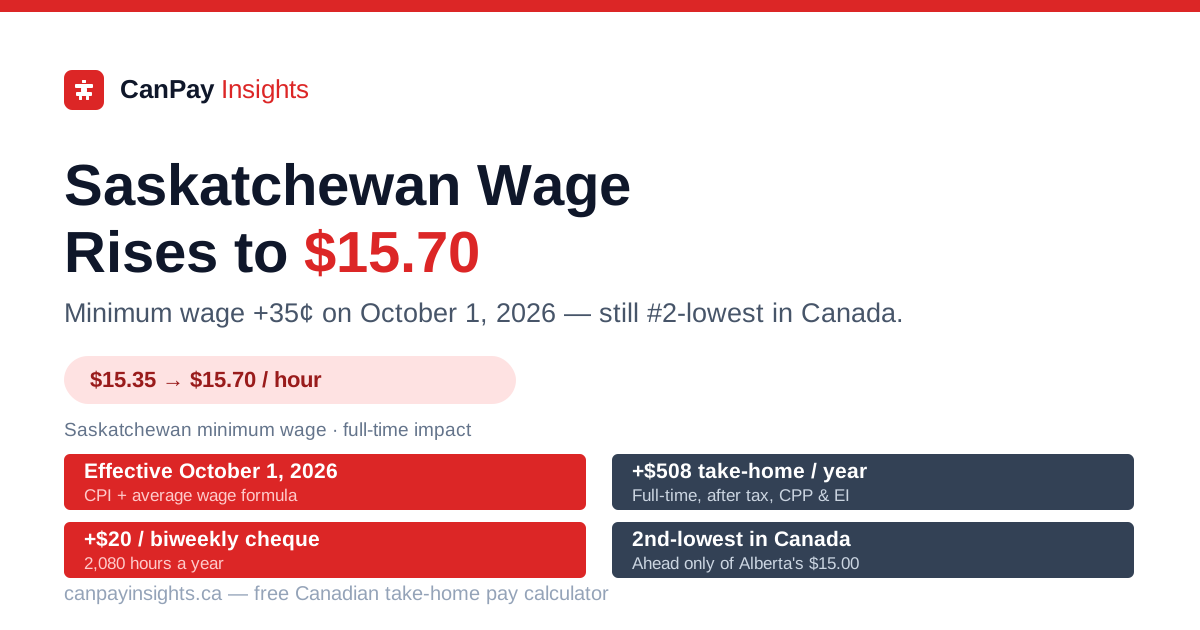
Saskatchewan's general minimum wage rose from $15.35 to $15.70 an hour on October 1, 2026, a 35-cent increase set under the province's indexation formula, which gives equal weight to changes in the Consumer Price Index and the average hourly wage in Saskatchewan. Running the new rate through the CanPay Insights tax engine, a full-time (2,080 hours/year) minimum wage worker in Saskatchewan gained about $508 more take-home pay a year — roughly $20 more per biweekly paycheque. Even after the increase, Saskatchewan keeps Canada's second-lowest minimum wage, ahead only of Alberta's $15.00, which has been frozen since 2018.
Saskatchewan's rate caught up on October 1
Saskatchewan's general minimum wage rose from $15.35 to $15.70 an hour on October 1, 2026 — a 35-cent increase set under the province's indexation formula, which gives equal weight to the change in the Consumer Price Index and the change in Saskatchewan's average hourly wage over the previous year. The province confirmed the new rate on June 29, 2026.
That put Saskatchewan on the same effective date as four other provinces also raising their minimum wage on October 1, 2026: Ontario, Nova Scotia, Prince Edward Island, and Manitoba. Five provinces moved on the same day this fall, but each sets its own rate independently through its own formula or legislation.
We ran Saskatchewan's new rate through the CanPay Insights tax engine (2026 federal and provincial brackets, CPP, and EI) to see exactly how much of the raise survives payroll deductions.
The rate, in one table
| Rate | Change | Effective | |
|---|---|---|---|
| Old rate | $15.35/hr | — | October 2025 – September 2026 |
| New rate | $15.70/hr | +$0.35 | Since October 1, 2026 |
| Formula | CPI + average hourly wage, averaged | — | Annual review |
What it's actually worth after tax
Full-time hours (40/week, 2,080/year), 2026 federal and Saskatchewan tax rates, CPP, EI, and basic personal amounts only:
| Rate | Gross pay/year | Take-home pay/year | Take-home/biweekly | Extra vs. old rate | Extra/cheque |
|---|---|---|---|---|---|
| $15.35/hr (old) | $31,928 | $27,089 | $1,042 | — | — |
| $15.70/hr (since Oct 1) | $32,656 | $27,597 | $1,061 | +$508/yr | +$20 |
Calculated by CanPay Insights using the 2026 tax engine for a single Saskatchewan worker with no other income or credits, paid biweekly (26 pay periods).
Why the after-tax gain is smaller than the raise looked
A 35-cent raise sounds like $728 more a year (35 cents × 2,080 hours) — but only about $508 of that survived payroll deductions, because the extra income is taxed and subject to CPP and EI exactly like the rest of the paycheque. In practice, a Saskatchewan minimum wage worker keeps roughly 70 cents of every extra dollar from this raise; the rest goes to federal tax, Saskatchewan provincial tax, CPP, and EI.
Still Canada's second-lowest minimum wage
Even at $15.70, Saskatchewan stays near the bottom of the national ranking. Alberta remains the only province paying less, at a flat $15.00 an hour — frozen since October 2018, with no increase announced for 2026. New Brunswick, which raised its own rate to $15.90 in April 2026, now pays 20 cents more per hour than Saskatchewan's rate. For the full national picture across all 13 provinces and territories, see our minimum wage take-home pay study.
See your own numbers
These figures assume a single worker with no other income or credits. To check your own paycheque under the new rate, use the free Saskatchewan paycheck calculator, see the Saskatchewan take-home pay guide, or compare it against every other province with compare provinces.
Sources & disclaimer
Rate and effective-date figures are based on the Government of Saskatchewan's June 29, 2026 announcement of its minimum wage increase and the province's published indexation formula, cross-checked against contemporaneous reporting by the Prince Albert Daily Herald and MBC Radio. Take-home figures are calculated with the CanPay Insights tax engine using 2026 federal and Saskatchewan provincial rates, full-time hours (2,080/year), a single worker, and basic personal amounts only — real paycheques vary with credits, benefits, and actual hours worked. This is general information, not tax advice.
Calculate Your Take-Home Pay
Enter your salary and province to see detailed tax breakdowns instantly.
Use Free CalculatorFrequently Asked Questions
What is Saskatchewan's new minimum wage for October 2026?⌄
Why wasn't Saskatchewan included when Ontario, Nova Scotia, PEI and Manitoba raised minimum wage on the same date?⌄
How much extra did a full-time Saskatchewan minimum wage worker take home?⌄
Is Saskatchewan still the lowest minimum wage in Canada?⌄
Does Saskatchewan review its minimum wage every year?⌄
Does the minimum wage increase affect CPP and EI deductions?⌄
Share this article
Help others learn about Canadian taxes
Disclaimer: This content is based on publicly available information and general tax knowledge for reference only. Individual tax situations may vary. Please consult a qualified tax professional or accountant for personalized advice.