Quick Answer
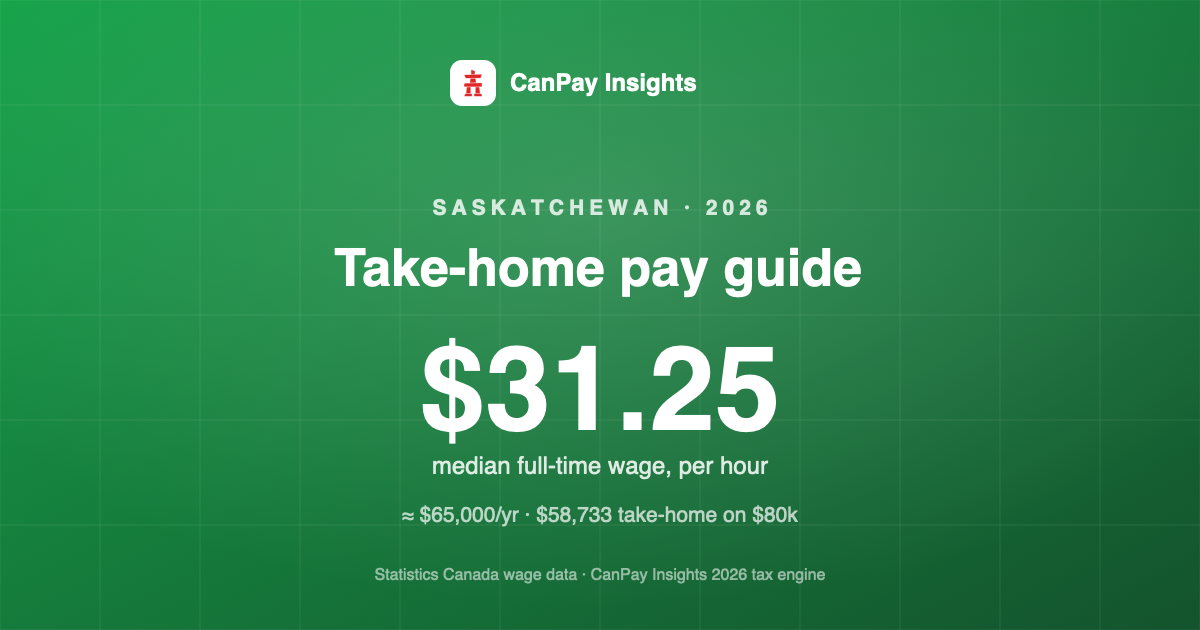
The median full-time wage in Saskatchewan is $31.25 an hour, about $65,000 a year, which leaves roughly $49,588 after tax in 2026. On an $80,000 salary, Saskatchewan ranks #7 of 13 provinces and territories for take-home pay, keeping $59,022.
The typical Saskatchewan paycheque
Across all industries, the median full-time wage in Saskatchewan is $31.25 an hour — about $65,000 a year. After federal tax, Saskatchewan tax, CPP/CPP2 and EI, a single employee on that salary keeps roughly $49,588 a year, or $4,132 a month. That is 76.3% of gross pay.
Take-home pay in Saskatchewan at every salary level
Nobody is paid an "average". Here is what specific salaries actually leave in Saskatchewan for the 2026 tax year — federal tax, provincial tax, CPP/CPP2 and EI, for a single employee with no extra credits.
| Gross salary | Take-home (year) | Per month | Kept |
|---|---|---|---|
| $40,000 | $32,721 | $2,727 | 81.8% |
| $60,000 | $46,520 | $3,877 | 77.5% |
| $80,000 | $59,022 | $4,918 | 73.8% |
| $100,000 | $72,288 | $6,024 | 72.3% |
| $150,000 | $104,037 | $8,670 | 69.4% |
Notice how the share you keep falls as the salary rises: that is Canada's progressive tax system working as designed. At $40,000 you keep 81.8%; at $150,000 you keep 69.4%.
What each industry pays in Saskatchewan
Statistics Canada publishes the median wage of full-time employees by industry. Here is every sector it reports for Saskatchewan, with what each one leaves after Saskatchewan tax, federal tax, CPP and EI in 2026.
| Industry | Median wage | ≈ Annual | Take-home |
|---|---|---|---|
| Forestry, fishing, mining, oil & gas | $50.00/hr | $104,000 | $74,968 |
| Utilities | $46.00/hr | $95,700 | $69,407 |
| Public administration | $42.00/hr | $87,400 | $63,846 |
| Educational services | $39.23/hr | $81,600 | $60,051 |
| Professional, scientific & technical services | $38.46/hr | $80,000 | $59,022 |
| Finance, insurance & real estate | $33.85/hr | $70,400 | $52,920 |
| Manufacturing | $32.66/hr | $67,900 | $51,367 |
| Construction | $32.00/hr | $66,600 | $50,569 |
| Information, culture & recreation | $31.50/hr | $65,500 | $49,894 |
| Transportation & warehousing | $30.00/hr | $62,400 | $47,992 |
| Healthcare & social assistance | $28.05/hr | $58,300 | $45,426 |
| Agriculture | $28.00/hr | $58,200 | $45,359 |
| Other services | $27.50/hr | $57,200 | $44,681 |
| Wholesale & retail trade | $24.61/hr | $51,200 | $40,537 |
| Business & support services | $21.00/hr | $43,700 | $35,303 |
| Food service & hospitality | $17.00/hr | $35,400 | $29,512 |
The best-paid sector reported here is forestry, fishing, mining, oil & gas at $50.00 an hour; the lowest is food service & hospitality at $17.00. That gap — $33.00 an hour — works out to about $68,600 a year before tax.
How Saskatchewan compares with the rest of Canada
On an $80,000 salary, Saskatchewan ranks #7 of 13 provinces and territories for take-home pay in 2026.
| Rank | Province | Take-home on $80,000 |
|---|---|---|
| 1 | Nunavut | $62,299 |
| 2 | Northwest Territories | $61,166 |
| 3 | British Columbia | $61,157 |
| 4 | Yukon | $61,039 |
| 5 | Alberta | $60,698 |
| 6 | Ontario | $60,303 |
The difference between Saskatchewan and Nunavut, the highest, is $3,277 a year on the same $80,000 salary — about $273 a month.
Take-home pay is only one side of a move, of course: rent, groceries and childcare vary as much as tax does. But it is the side most people guess at, and it is the side that can be calculated exactly.
Where people work in Saskatchewan
Most Saskatchewan employees are in Saskatoon, Regina and Prince Albert. Wherever you are in the province, the provincial tax rules are the same — there is no city income tax anywhere in Canada, so your postal code changes your rent, not your deductions.
Run your own numbers
Every figure above is a median or a computed example. Your own pay depends on your exact salary or hourly rate, overtime, shift premiums, RRSP contributions and benefits. The take-home pay calculator handles all of it for Saskatchewan and every other province, for the 2026 tax year, with no signup.
Wage figures: Statistics Canada, Table 14-10-0064-01, median hourly wage of full-time employees, 2025, annualised at 2,080 hours. Take-home figures: CanPay Insights 2026 tax engine (federal and provincial income tax, CPP/CPP2, EI) for a single employee with no additional credits.
Calculate Your Take-Home Pay
Enter your salary and province to see detailed tax breakdowns instantly.
Use Free CalculatorFrequently Asked Questions
What is the average salary in Saskatchewan?⌄
What is the take-home pay on $80,000 in Saskatchewan?⌄
Does Saskatchewan have high taxes compared with other provinces?⌄
Which industry pays best in Saskatchewan?⌄
How much of my pay do I keep in Saskatchewan?⌄
Share this article
Help others learn about Canadian taxes
Disclaimer: This content is based on publicly available information and general tax knowledge for reference only. Individual tax situations may vary. Please consult a qualified tax professional or accountant for personalized advice.