Quick Answer
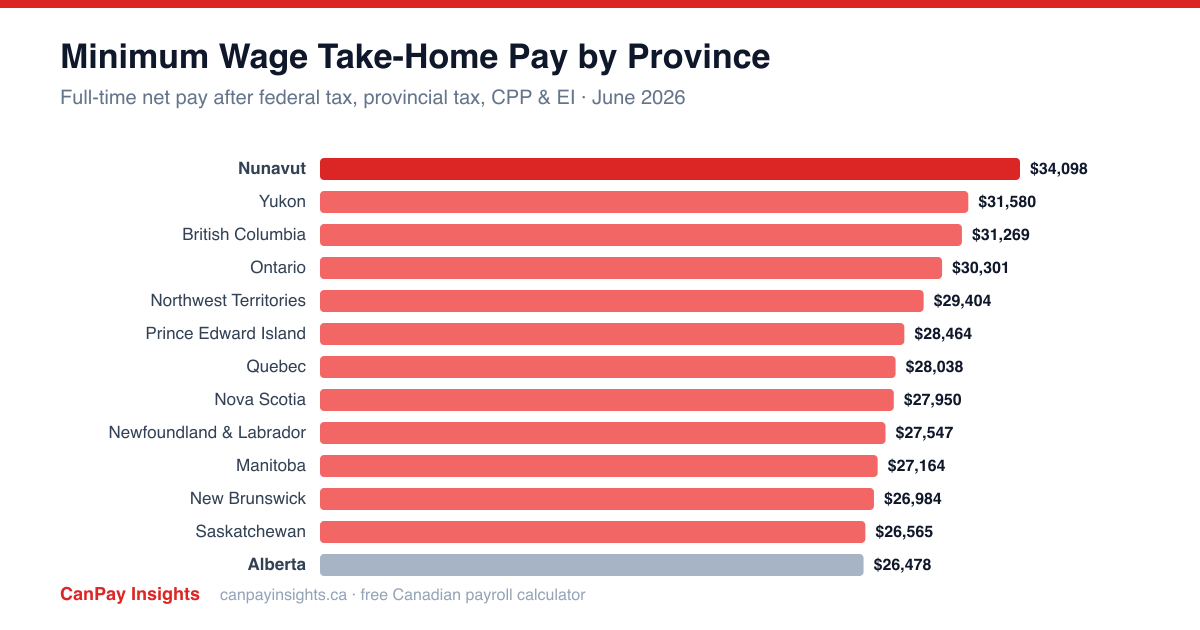
As of June 2026, a full-time minimum wage worker takes home between $26,779 a year (Alberta, $15.00/hr) and $34,393 a year (Nunavut, $19.75/hr) after federal tax, provincial tax, CPP, and EI. In Ontario ($17.60/hr), full-time minimum wage works out to $30,179 a year or about $2,515 a month after deductions.
What Minimum Wage Is Really Worth in 2026
Minimum wage headlines always quote the hourly rate. But a $17.00 wage in one province and a $16.60 wage in another can leave a worker with almost the same money in the bank, because provincial taxes and payroll deductions differ sharply across Canada.
We ran every provincial and territorial minimum wage (current as of June 12, 2026) through the CanPay Insights tax engine to answer one question: what does a full-time minimum wage worker actually keep?
Key findings
- The national gap is $7,614 a year. A full-time minimum wage worker in Nunavut takes home $34,393; in Alberta, $26,779.
- Nova Scotia takes the biggest bite. Deductions consume 19.2% of a minimum wage salary in Nova Scotia — the highest in Canada. Alberta takes the smallest share (14.2%), but its $15.00 wage is so low that Alberta workers still finish last in actual dollars.
- PEI's higher wage mostly evaporates. PEI's $17.00 wage is 40 cents above Quebec's $16.60, but after deductions the difference shrinks to about $44 a month.
- Saskatchewan nearly catches Manitoba. Saskatchewan pays 65 cents less per hour than Manitoba, but its lower deductions close the annual net gap to just $415.
Full results: minimum wage take-home pay by province (June 2026)
Figures assume full-time hours (40 hours/week, 2,080 hours/year), basic personal amounts only, and 2026 tax rates.
| Province | Min. wage | Gross (full-time) | Take-home / year | Take-home / month | Net hourly | Deduction rate |
|---|---|---|---|---|---|---|
| Nunavut | $19.75 | $41,080 | $34,393 | $2,866 | $16.54 | 16.3% |
| Yukon | $18.51 | $38,501 | $31,846 | $2,654 | $15.31 | 17.3% |
| British Columbia | $18.25 | $37,960 | $31,536 | $2,628 | $15.16 | 16.9% |
| Ontario | $17.60 | $36,608 | $30,179 | $2,515 | $14.51 | 17.6% |
| Northwest Territories | $16.95 | $35,256 | $29,643 | $2,470 | $14.25 | 15.9% |
| Prince Edward Island | $17.00 | $35,360 | $28,831 | $2,403 | $13.86 | 18.5% |
| Quebec | $16.60 | $34,528 | $28,300 | $2,358 | $13.61 | 18.0% |
| Nova Scotia | $16.75 | $34,840 | $28,137 | $2,345 | $13.53 | 19.2% |
| Newfoundland and Labrador | $16.35 | $34,008 | $27,899 | $2,325 | $13.41 | 18.0% |
| Manitoba | $16.00 | $33,280 | $27,294 | $2,275 | $13.12 | 18.0% |
| New Brunswick | $15.90 | $33,072 | $27,160 | $2,263 | $13.06 | 17.9% |
| Saskatchewan | $15.35 | $31,928 | $26,879 | $2,240 | $12.92 | 15.8% |
| Alberta | $15.00 | $31,200 | $26,779 | $2,232 | $12.87 | 14.2% |
Deduction rate = (federal tax + provincial tax + CPP/QPP + EI, and QPIP in Quebec) as a share of gross pay.
The hourly rate you never see on the poster
Translating take-home pay back into an hourly figure shows how much of every advertised minimum wage hour a worker actually keeps:
- Nunavut: $19.75 advertised → $16.54 in the bank
- Ontario: $17.60 advertised → $14.67 in the bank
- Quebec: $16.60 advertised → $13.61 in the bank
- Alberta: $15.00 advertised → $12.87 in the bank
No Canadian jurisdiction lets a full-time minimum wage worker keep more than 86% of their gross pay.
Why the deduction rates differ so much
At minimum wage income levels ($31,000–$41,000 a year), three things drive the differences:
- Provincial basic personal amounts. Provinces with low basic personal amounts — Nova Scotia ($11,932) and Ontario ($12,989) are among the lowest — start taxing income much earlier than Alberta ($22,769) or the territories, and Nova Scotia pairs that with the highest bottom-bracket rate in the country (8.79%).
- Quebec's separate system. Quebec layers QPP (at a higher rate than CPP) and QPIP on top of income tax, partly offset by the federal Quebec abatement.
- CPP and EI are flat at this level. CPP (5.95%) and EI (1.63%) apply almost uniformly, so they hit low earners proportionally harder than higher earners who exceed the contribution ceilings.
Wage increases already scheduled for late 2026
Four provinces have announced October 1, 2026 increases that will shift these numbers:
- Ontario: $17.60 → $17.95
- Manitoba: $16.00 → $16.40
- Prince Edward Island: $17.00 → $17.30
- Nova Scotia: $16.75 → $17.00
We will update this study when the new rates take effect.
Methodology
Calculations use the CanPay Insights tax engine with 2026 federal and provincial tax brackets, CPP/CPP2 (QPP/QPP2 and QPIP for Quebec), and EI premiums. We assume a single worker, full-time hours (2,080 hours/year), no RRSP contributions, no benefits, and basic personal amounts only. Real paycheques will vary with credits, benefits, and actual hours. Minimum wage rates are current as of June 12, 2026, sourced from the Government of Canada minimum wage database and provincial announcements.
You can verify any figure with our free payroll calculator or the province pages, for example the Ontario paycheck calculator and the hourly wage calculator.
This study is free to cite and republish with attribution and a link to this page.
Calculate Your Take-Home Pay
Enter your salary and province to see detailed tax breakdowns instantly.
Use Free CalculatorFrequently Asked Questions
How much does a minimum wage worker take home in Ontario in 2026?⌄
Which province has the highest minimum wage take-home pay in Canada?⌄
How much tax does a minimum wage worker pay in Canada?⌄
Is minimum wage in BC or Ontario worth more after tax?⌄
Share this article
Help others learn about Canadian taxes
Disclaimer: This content is based on publicly available information and general tax knowledge for reference only. Individual tax situations may vary. Please consult a qualified tax professional or accountant for personalized advice.