Quick Answer
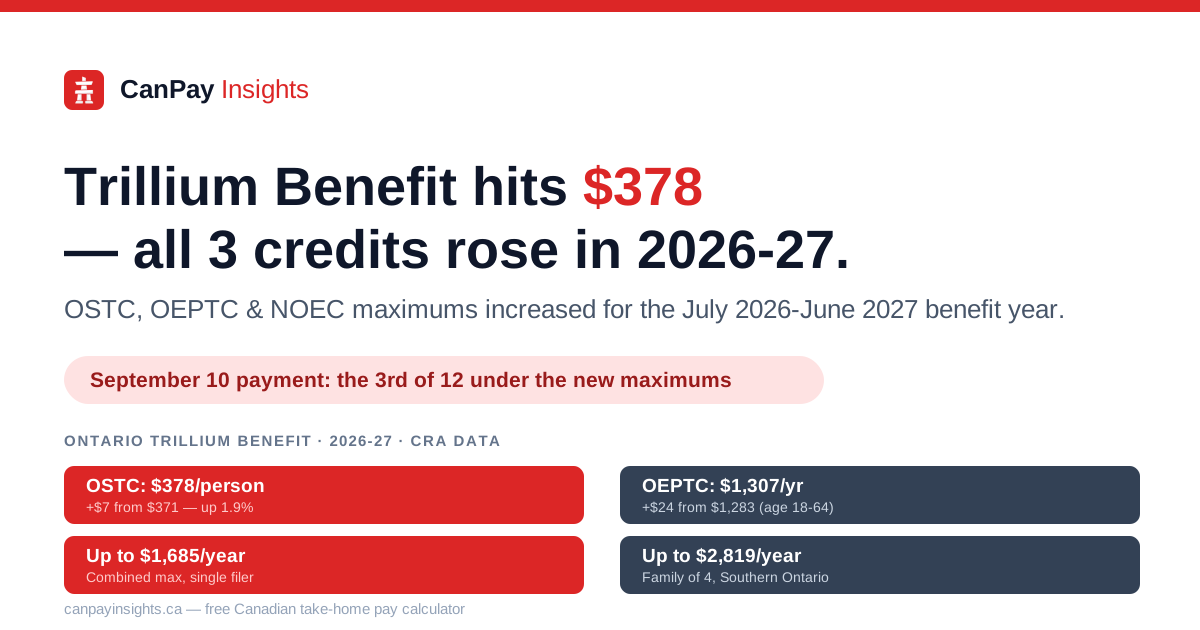
For the July 2026 to June 2027 benefit year (based on your 2025 tax return), the Ontario Trillium Benefit's three credits all rose about 1.9%: the Ontario Sales Tax Credit (OSTC) now maxes out at $378 per adult and per child (up from $371), the Ontario Energy and Property Tax Credit (OEPTC) at $1,307 a year for those 18-64 and $1,488 for seniors 65+ (up from $1,283 and $1,461), and the Northern Ontario Energy Credit (NOEC) at $189 for a single person with no children and $290 for a couple or single parent (up from $185 and $285). The CRA pays the combined total on the 10th of each month; the September 10, 2026 deposit was the third of twelve payments under the new rates, and most recipients see the same amount they got in July and August unless their eligibility changed.
Three credits, one deposit, all up about 1.9%
The Ontario Trillium Benefit (OTB) — the combined monthly payment that folds together the Ontario Sales Tax Credit (OSTC), the Ontario Energy and Property Tax Credit (OEPTC), and, for Northern Ontario residents, the Northern Ontario Energy Credit (NOEC) — increased across all three components for the July 2026 to June 2027 benefit year, based on 2025 tax returns. The September 10, 2026 deposit was the third payment issued under the new, higher maximums, following the first payment on July 10.
We pulled the exact caps from the Canada Revenue Agency's own OTB calculation sheets to see exactly what changed.
The new maximums, in one table
| Credit | 2025-26 maximum | 2026-27 maximum | Change |
|---|---|---|---|
| Ontario Sales Tax Credit (OSTC), per adult/child | $371 | $378 | +$7 (+1.9%) |
| Ontario Energy and Property Tax Credit (OEPTC), age 18-64 | $1,283 | $1,307 | +$24 (+1.9%) |
| Ontario Energy and Property Tax Credit (OEPTC), age 65+ | $1,461 | $1,488 | +$27 (+1.8%) |
| Northern Ontario Energy Credit (NOEC), single, no children | $185 | $189 | +$4 (+2.2%) |
| Northern Ontario Energy Credit (NOEC), couple/single parent | $285 | $290 | +$5 (+1.8%) |
Figures for the OEPTC and NOEC are from the CRA's official 2026 calculation sheets; OSTC and prior-year figures corroborated against multiple independent tax-benefit trackers.
What that adds up to for a real household
The OTB pays out the sum of whichever credits you qualify for. Assuming you claim the full maximum of each (income and housing costs below the phase-out point):
| Household | OSTC | OEPTC | NOEC (Northern only) | Max annual OTB | Max monthly |
|---|---|---|---|---|---|
| Single, no children, Southern Ontario | $378 | $1,307 | — | $1,685 | $140 |
| Single senior (65+), Southern Ontario | $378 | $1,488 | — | $1,866 | $156 |
| Single, no children, Northern Ontario | $378 | $1,307 | $189 | $1,874 | $156 |
| Family of 4 (2 adults, 2 kids), Southern Ontario | $1,512 | $1,307 | — | $2,819 | $235 |
| Family of 4 (2 adults, 2 kids), Northern Ontario | $1,512 | $1,307 | $290 | $3,109 | $259 |
The OSTC pays a flat $378 for every adult and every child in the household, which is why it scales directly with family size; the OEPTC and NOEC are capped per household regardless of how many people live there.
The income test: where it phases out
None of this is a flat payment — all three credits shrink as income rises. Using the CRA's official calculation sheets:
- OEPTC is reduced by 2% of adjusted family net income above $29,047 (single, no children) or $36,309 (single parents and couples, with or without children).
- OSTC is reduced by 4% of adjusted family net income above those same thresholds.
For a childless single person claiming only the OSTC and OEPTC (combined maximum $1,685, combined reduction rate 6% since both credits share the $29,047 threshold), the benefit is fully phased out around $57,100 in adjusted net income. Higher-income families phase out at a higher dollar figure because their starting entitlement — more people, more rent or property tax — is larger to begin with.
Payment schedule for the rest of the 2026-27 benefit year
The CRA pays the combined OTB on the 10th of each month (or the nearest business day) for twelve months, from July 2026 through June 2027:
| Payment | Date |
|---|---|
| 1st | July 10, 2026 |
| 2nd | August 10, 2026 |
| 3rd | September 10, 2026 |
| 4th | October 2026 |
| 5th | November 2026 |
| 6th | December 2026 |
| ... | continues monthly through June 2027 |
If your total annual entitlement works out to $500 or less, the CRA pays the whole year's amount as one lump sum in July rather than spreading it over 12 months. You can also elect on your tax return to receive your entire annual entitlement as a single payment the following June instead of monthly instalments.
How this fits alongside your paycheque
The OTB isn't payroll income — it never touches a pay stub, and it isn't taxed or affected by your employer's CPP, EI, or income tax withholding. But because it phases out with income, a raise at work can shrink your OTB even as your take-home pay grows, and the two numbers don't move at the same rate. If you're weighing a raise, more hours, or a new job against how it affects benefits like the OTB, keep the calculations separate: check what a raise actually nets you after tax with the free CanPay Insights salary calculator or the Ontario paycheck calculator, and use your adjusted net income from your tax return — not your after-tax pay — for any benefit's income test.
For other federal benefits also paying out or changing this fall, see our coverage of the Canada Child Benefit increase, the Canada Workers Benefit, and the Canada Groceries and Essentials Benefit. For Ontario's tax brackets and take-home pay more broadly, see the Ontario page.
Sources & disclaimer
2026-27 OEPTC and NOEC maximums, income thresholds, and phase-out rates are taken directly from the Canada Revenue Agency's official 2026 Ontario Energy and Property Tax Credit calculation sheets (single, no children; single with sole care of a child; and single seniors versions) and the 2026 Northern Ontario Energy Credit calculation sheets. The $378 OSTC maximum is confirmed on the CRA's Ontario Trillium Benefit program pages; 2025-26 prior-year figures ($371, $1,283, $1,461, $185, $285) are corroborated across independent tax-benefit trackers and are internally consistent with the confirmed 2026-27 indexation rate of roughly 1.9%. Combined household totals and phase-out breakeven points are CanPay Insights' own calculations from these official maximums and thresholds. This is general information, not tax advice — confirm your own entitlement with the CRA's Ontario Trillium Benefit page or a tax professional.
Calculate Your Take-Home Pay
Enter your salary and province to see detailed tax breakdowns instantly.
Use Free CalculatorFrequently Asked Questions
How much is the Ontario Trillium Benefit in 2026?⌄
When is the Ontario Trillium Benefit paid in 2026?⌄
Why did my Ontario Trillium Benefit go up this year?⌄
At what income does the Ontario Trillium Benefit stop?⌄
Do I need to apply for the Ontario Trillium Benefit?⌄
How does the Ontario Trillium Benefit relate to my paycheque?⌄
Share this article
Help others learn about Canadian taxes
Disclaimer: This content is based on publicly available information and general tax knowledge for reference only. Individual tax situations may vary. Please consult a qualified tax professional or accountant for personalized advice.