Quick Answer
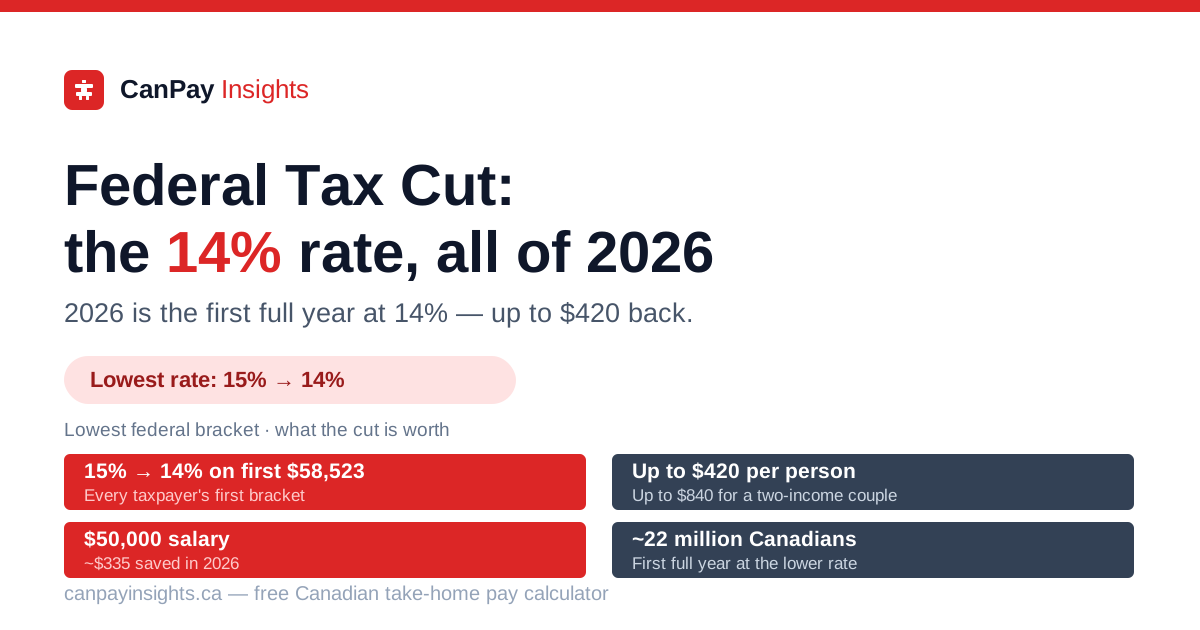
The federal government reduced Canada's lowest personal income tax rate from 15% to 14%, effective July 1, 2025. Because the cut landed mid-year, the 2025 full-year rate was a blended 14.5%; 2026 is the first full calendar year at 14%, so it delivers the complete benefit. The maximum saving is $420 per person in 2026 (up to $840 for a two-income couple), reached once your taxable income passes the top of the first bracket ($58,523). Roughly 22 million Canadians benefit, which is why many workers' 2026 paycheques are slightly larger than their 2025 ones even with no raise.
The federal rate is 14% now — and 2026 is the first full year of it
If your 2026 paycheque looks slightly bigger than your 2025 one and you haven't had a raise, this is a big part of why. The federal government cut Canada's lowest personal income tax rate from 15% to 14%, and 2026 is the first full calendar year the lower rate applies from the very first pay period.
The cut took effect July 1, 2025. Because it landed halfway through that year, the Canada Revenue Agency set the 2025 full-year rate at a blended 14.5% — you got 15% for the first half and 14% for the second. In 2026 the flat 14% applies all year, so the full benefit finally shows up. The change was made permanent by Bill C-4, the Making Life More Affordable for Canadians Act, which received Royal Assent on March 12, 2026.
The 14% rate applies to the first $58,523 of taxable income — the first federal bracket. Everything above that is taxed at the unchanged higher rates (20.5%, 26%, 29% and 33%). Because the first bracket is the one every taxpayer passes through, roughly 22 million Canadians benefit, regardless of income.
The rate, in one table
| Tax year | Lowest federal rate | Why |
|---|---|---|
| 2024 and earlier | 15% | Pre-cut rate |
| 2025 (full year) | 14.5% (blended) | Cut took effect July 1, 2025 — only half a year at 14% |
| 2026 (full year) | 14% | First full year at the reduced rate |
| 2027 onward | 14% | Permanent under Bill C-4 |
What the cut is worth to you
The maximum saving is $420 per person in 2026, and up to $840 for a two-income couple. But not everyone reaches the maximum. The saving is essentially the 1% rate cut applied to the income you have taxed in the first bracket above the basic personal amount ($16,452 federally in 2026) — so it climbs with income until you hit the top of the first bracket ($58,523), then flattens.
| Annual salary | Approx. federal tax cut saving (2026) |
|---|---|
| $30,000 | ~$135 |
| $40,000 | ~$235 |
| $50,000 | ~$335 |
| $60,000 | ~$420 (maximum) |
| $75,000 | ~$420 (maximum) |
| $90,000 | ~$420 (maximum) |
| $120,000 | ~$420 (maximum) |
Calculated by CanPay Insights using the 2026 federal bracket ($58,523 at 14%) and basic personal amount ($16,452). The saving is the difference between federal tax at 15% and at 14% on first-bracket income, net of the small offset from valuing credits at 14% instead of 15%. This matches the government's stated maximum of $420 per person. Figures use basic personal amounts only and exclude provincial tax and other credits.
The maximum lands at about $420 once taxable income passes $58,523 — and it stays flat above that, because the cut only touches the first bracket. A worker earning $250,000 gets the same $420 from this measure as a worker earning $60,000.
On your actual paycheque
Spread across the year, $420 is roughly $16 more per biweekly cheque (26 pay periods) for someone above the first-bracket threshold, or about $35 a month. Someone at $50,000 keeps about $335 more for the year, roughly $13 a paycheque. It is not dramatic on any single payday — but it is real money that shows up automatically, without filing anything, because employers' 2026 payroll tables already build in the 14% rate.
How it stacks with everything else in 2026
The federal cut is one of several 2026 changes moving take-home pay in different directions. On its own it is a modest raise; some provincial moves partly offset it. For example, British Columbia raised its lowest rate to 5.60% for 2026, and CPP/EI figures were reset at the start of the year. To see the combined, province-specific result on your own pay, use the free salary after tax calculator, the Ontario paycheck calculator, or compare provinces side by side.
The bottom line
Canada's lowest federal income tax rate is 14% for 2026, down from 15%, and 2026 is the first full year of it. It is automatic, permanent, and worth up to $420 per person ($840 per couple) — the reason many paycheques quietly grew in January 2026 with no raise attached. Check exactly what it means for your take-home with the free take-home pay calculator.
Sources & disclaimer
Based on the Government of Canada's announcement Delivering a middle-class tax cut and the Prime Minister's office release Canada's new government delivers middle-class tax cut, cross-checked against professional summaries from Invesco Canada and BDO Canada and reporting by CBC News. The $420 maximum and the 15%-to-14% rate, July 1, 2025 effective date, 14.5% blended 2025 rate and 14% full-year 2026 rate are drawn from those government sources. Savings by salary are calculated by CanPay Insights from the published 2026 federal bracket and basic personal amount and are not themselves quoted from a government source. This is general information, not tax or financial advice — confirm current figures with the Canada Revenue Agency or Department of Finance Canada.
Calculate Your Take-Home Pay
Enter your salary and province to see detailed tax breakdowns instantly.
Use Free CalculatorFrequently Asked Questions
What is the new federal tax rate for 2026?⌄
How much is the federal tax cut worth in 2026?⌄
Why is my paycheque bigger in 2026 than in 2025?⌄
Does everyone get the full $420?⌄
Is the middle-class tax cut permanent?⌄
Does the rate cut change CPP, EI or provincial tax?⌄
Share this article
Help others learn about Canadian taxes
Disclaimer: This content is based on publicly available information and general tax knowledge for reference only. Individual tax situations may vary. Please consult a qualified tax professional or accountant for personalized advice.