Quick Answer
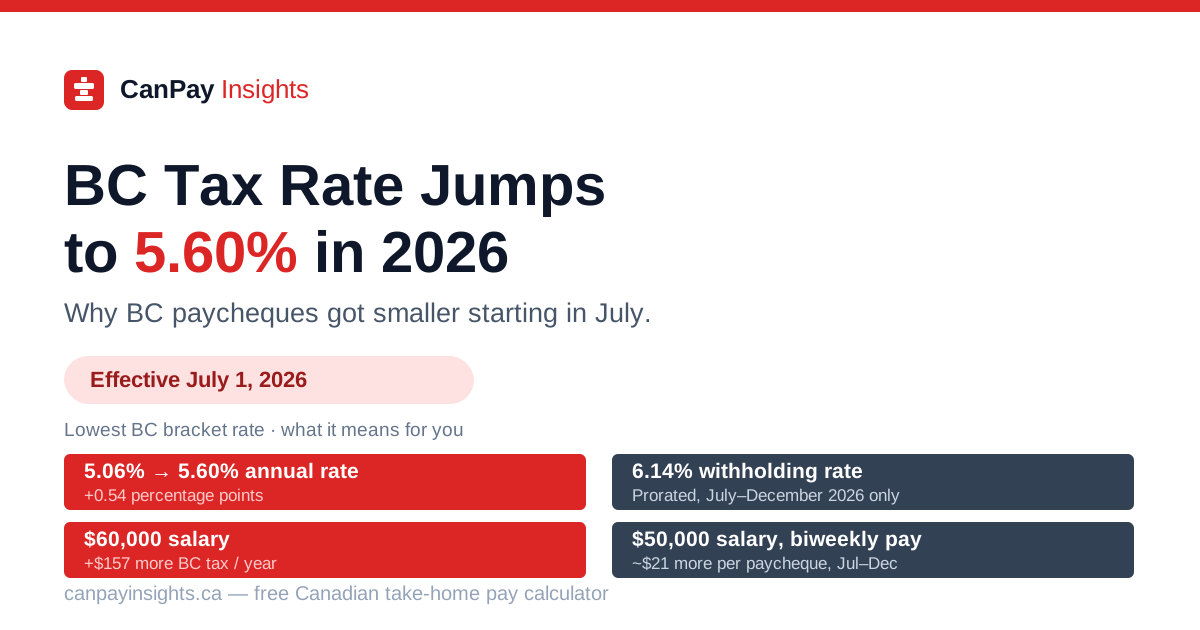
British Columbia's lowest personal income tax rate rose from 5.06% to 5.60% for all of 2026, under a budget tabled February 17, 2026. Because payroll software had already withheld six months of pay at the old 5.06% rate before the change was finalized, the CRA's July 2026 payroll tables apply a prorated rate of 6.14% to BC's first tax bracket from July through December 2026, so the full year averages out to 5.60%. In practice, this made BC paycheques noticeably smaller starting with the first July payday, on top of the roughly $130–$165 a year the rate increase itself adds for anyone earning $40,000 or more.
Why BC take-home pay dropped starting in July
If you work in British Columbia and noticed your paycheque was a little smaller starting with your first July 2026 payday — and nothing else about your job changed — this is almost certainly why: the province's lowest income tax rate went up, and payroll withholding only caught up to it halfway through the year.
British Columbia's budget, tabled February 17, 2026, raised the lowest personal income tax rate from 5.06% to 5.60% for the 2026 taxation year and beyond — a 0.54 percentage point increase on the first $50,363 of taxable income. The government also raised the BC tax reduction credit, which softens the impact for lower earners, from $575 to $690 for 2026.
The trouble is timing. The Canada Revenue Agency finalizes its annual T4127 Payroll Deductions Formulas guide before most provincial budgets are even tabled, so employers spent January through June 2026 withholding BC tax at the old 5.06% rate. Once BC's budget became law, the CRA had to correct course. Its July 2026 payroll update (the guide effective July 1, 2026) applies BC's lowest bracket at a prorated 6.14% rate for July through December 2026 — higher than even the real 5.60% annual rate — so that six months of catch-up withholding brings the full year back in line with what BC residents actually owe.
The rate, in one table
| Period | BC lowest-bracket rate | Why |
|---|---|---|
| 2025 (all year) | 5.06% | Pre-budget rate |
| Jan – Jun 2026 | 5.06% | Payroll hadn't updated for the new budget yet |
| Jul – Dec 2026 | 6.14% (prorated) | Catches up the shortfall from Jan–Jun |
| 2026, full-year average | 5.60% | The real, legislated 2026 rate |
| 2027 onward (expected) | 5.60% | Applied evenly all year, assuming no further change |
What it costs you for the pay period
The 6.14% figure only applies to income taxed in BC's first bracket, and only for July through December 2026 — it is a temporary correction, not BC's permanent rate. For someone earning $50,000 a year (fully inside the first bracket) paid biweekly, that works out to roughly $21 more withheld per paycheque from July through December compared with what a level 5.60% rate would have taken all year — because the second half of the year is carrying the whole correction on its own.
What it costs you for the full year
Ignoring the mid-year withholding mechanics and just comparing BC's 2025 tax brackets and basic personal amounts against 2026's, here's what the rate increase is actually worth annually, using basic personal amounts only:
| Annual salary | 2025 BC tax (5.06% bracket) | 2026 BC tax (5.60% bracket) | Extra BC tax |
|---|---|---|---|
| $40,000 | $1,370 | $1,500 | +$130 |
| $50,000 | $1,895 | $2,060 | +$165 |
| $60,000 | $2,665 | $2,822 | +$158 |
| $75,000 | $3,820 | $3,977 | +$158 |
| $90,000 | $4,975 | $5,132 | +$158 |
Calculated by CanPay Insights from BC's published 2025 and 2026 tax brackets and basic personal amounts. The basic personal amount was $12,932 in 2025. It rose to $13,216 for 2026. The increase peaks around $50,000, in the narrow gap between the two years' bracket-one thresholds ($49,279 in 2025 vs. $50,363 in 2026), then settles to a flat roughly $158 a year for salaries between about $60,000 and $95,000. Figures exclude BC's income-tested tax reduction credit, which further lowers tax for net incomes under about $25,570.
The bottom line
BC's 2026 tax increase itself is modest — well under $200 a year for most workers. What actually surprised people was the timing: a mid-year jump in withholding that, on paper, looks bigger than the real annual change because it's cramming a full year's worth of extra tax into just six months of paycheques. By the time 2026 wraps up, total BC tax withheld should land close to the true 5.60%-rate amount; it's the last six months of the year carrying more than their fair share to get there.
For your own exact 2026 take-home pay by paycheque, use the free BC paycheck calculator or see how BC compares to other provinces with compare provinces. For the fuller picture on BC take-home pay this year, see the BC take-home pay guide 2026.
Sources & disclaimer
Based on the Province of British Columbia's official personal income tax rates page and the Canada Revenue Agency's T4127 Payroll Deductions Formulas — 123rd Edition, effective July 1, 2026, cross-checked against professional tax-alert summaries of BC's February 17, 2026 budget from PwC Canada and Doane Grant Thornton. Annual comparison figures are calculated by CanPay Insights from the published 2025 and 2026 BC tax brackets and basic personal amounts; they are not themselves quoted from a government source and exclude the BC tax reduction credit. This is general information, not tax or financial advice — confirm your own payroll deductions with your employer or the Canada Revenue Agency.
Calculate Your Take-Home Pay
Enter your salary and province to see detailed tax breakdowns instantly.
Use Free CalculatorFrequently Asked Questions
Why did my BC paycheque get smaller in July 2026?⌄
What is BC's new lowest tax rate for 2026?⌄
What is the 6.14% rate I keep seeing mentioned?⌄
How much more BC tax will I actually pay in 2026?⌄
Will my BC paycheque go back to normal in 2027?⌄
Does this rate change affect CPP or EI too?⌄
Share this article
Help others learn about Canadian taxes
Disclaimer: This content is based on publicly available information and general tax knowledge for reference only. Individual tax situations may vary. Please consult a qualified tax professional or accountant for personalized advice.